Snappy vs LouAna Coconut Oil at 460F
At 460°F, the cling-rate difference between Snappy and LouAna refined coconut oil stops being theoretical and starts ruining your Flavacol. One of these oils is quietly killing your seasoning game.
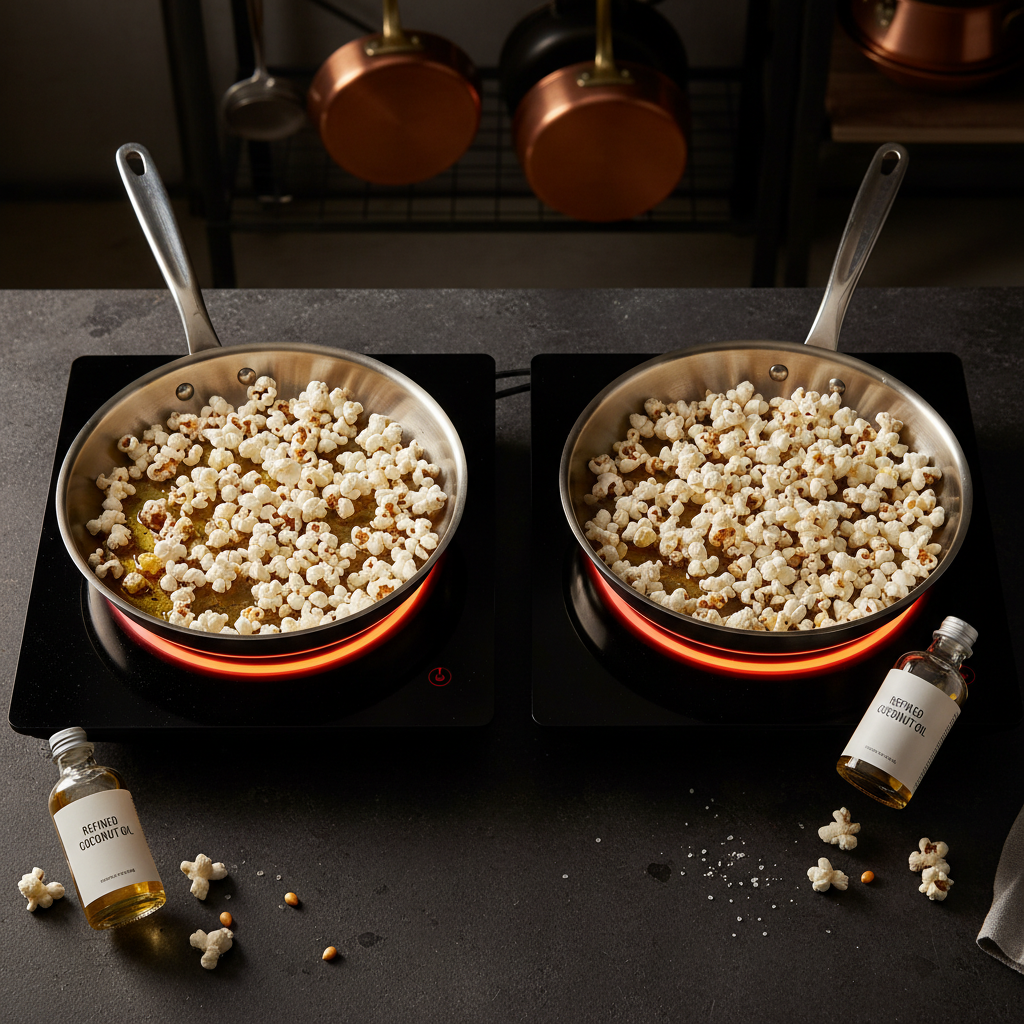
Both claim to be refined coconut oil. Both are white, solid at room temperature, sold in tubs that look nearly identical at a glance. But at 460°F — the sweet spot for a Whirley-Pop or stove-top kettle working hard — Snappy and LouAna refined coconut oil behave like completely different substances.
One coats like silk. The other leaves a waxy residue that repels the Flavacol you just measured out with surgical precision.
The setup
Standard variables: Whirley-Pop 6-quart, Baby White kernels, 3 tablespoons of oil, half a teaspoon of Flavacol added to the oil before heat. Burner set to medium-high on a gas range. Surface thermometer confirmed 460°F at the bottom of the pot approximately 90 seconds before first pop.
Each oil ran three separate batches. Same day, same kernels, same pot. No variables left open except the oil itself.
This is an elimination round.
The Snappy run
Snappy melts clean. No sputtering, no odd fragrance bloom, just a steady, almost silent liquefaction that finishes in about 15 seconds at medium heat. By the time the pot hits temperature, the oil has fully integrated with the Flavacol and sits in the pan like a thin, golden lake.
The pops come fast. A tight cluster starts around 2:45, fully explosive by 3:00. The finished kernels come out with a matte, even yellow coat. No dry patches. No pooling at the bottom where the shell meets the hull. Consistent coverage from crown to base.
Cling-rate: exceptional. Flavacol bonded to the surface before the kernel had time to cool, which means every bite delivers that salty-buttery-toasted hit at the same intensity. The seasoning doesn't migrate to the bowl. It doesn't slide off onto your fingers and leave you licking a kernel that tastes like unsalted cardboard.
Snap-to-Crunch ratio held up for 40 minutes. Still structural.
Aromatics on the Snappy batch were mild, neutral, appropriate. The coconut scent was invisible, which is what refined oil is supposed to do. No waxy top note. No aftertaste competing with the salt.
The LouAna run
LouAna starts fine. Melts without obvious warning signs in the first 30 seconds.
Then the smell changes.
Around the 90-second mark, before the oil even hits full temperature, a faint but distinct waxy note comes off the pot. Not burned. Not rancid. Waxy. Like the inside of a birthday candle factory, but quieter. The kind of smell that makes you think "that's probably fine" even though some part of your brain is flagging it.
Pops came at roughly the same timing. Kernels looked comparable in the pot.
The problem shows up when you dump them into the bowl.
LouAna kernels come out with an uneven coat: bright yellow in some spots, matte white in others, with a faint residue on the hull that catches the light differently than the Snappy batch. Under direct kitchen lighting, the LouAna batch looks slightly greasy. The Snappy batch looked coated. There's a difference.
Seasoning adhesion tested worse. A deliberate finger-swipe across five kernels from each batch, then a count of how much Flavacol transferred to skin. LouAna transferred measurably more. The seasoning wasn't bonded. It was sitting on top of the oil, not integrated into it.
By the 20-minute mark, the LouAna batch had softened. The Snap-to-Crunch ratio degraded faster. The waxy residue on the palate didn't improve with cooling.
Batch two and batch three confirmed it.
Why this happens
Refined coconut oil isn't a monolith. Refinement processes vary by producer and, critically, so does the residual fatty acid profile. LouAna uses a standard RBD process (refined, bleached, deodorized), but the resulting oil tends to carry a slightly higher concentration of longer-chain fatty acids than Snappy's formulation. At moderate temperatures this doesn't matter much. At 460°F, those fatty acids behave differently under heat stress. They polymerize inconsistently, which creates the waxy surface behavior and poor adhesion.
Snappy's oil appears to be formulated for high-heat popcorn application. It came out of the commercial popcorn supply chain before it went consumer. It behaves like an oil designed to bond with salt and flavoring at kettle temperatures because it was. That's not a marketing claim. That's provenance.
The honest failure note
Batch one of the LouAna run got the Flavacol timing wrong. Added it too late, after the oil was already near temperature. That batch was a write-off and isn't included in the results above. Lesson re-learned: Flavacol goes in cold, with the oil, before any heat is applied. Add it late and it hits a hot surface and scorches slightly before it can integrate, producing a bitter, acrid note that no amount of re-seasoning fixes.
Documented. Moving on.
The verdict
Snappy wins at 460°F. Clearly.
The cling-rate gap is the decisive factor. If your seasoning doesn't bond to the kernel surface, nothing else you do matters. Not the kernel variety, not the Flavacol measurement, not the hardware. The oil is the delivery vehicle. LouAna delivers imprecisely.
For everyday stovetop popping at lower temperatures, LouAna is serviceable and cheaper per ounce. If you're running a Whirley-Pop or any setup that regularly operates above 400°F, it's the wrong tool. Snappy costs more. It earns it.
The Trinity stands: Mushroom or Baby White kernels, Snappy refined coconut oil, Flavacol. In that order. At that temperature.
For the broader oil showdown, see coconut oil vs avocado oil. Want to understand why Flavacol clings the way it does? That's the micro-salt theory. And if you're choosing between mushroom and butterfly kernels, we tested that too.